86%
of employers expect AI to transform their business
By 2030, according to the World Economic Forum's global employer survey.

 Employee analysis
 Manager analysis
 Org analysisSolution
Cut the six hours a week each site manager loses to compiling progress reports.
By 2030, according to the World Economic Forum's global employer survey.
Against a national ambition of 10 million AI-skilled workers by 2030.
In employer spend on training over the past decade.
96% of levy payers haven't used their full levy.
Only a quarter of respondents to a McKinsey global survey saw a measurable improvement.
Of organisations lack a clear process for assessing the impact of learning.
Sources: 86%, World Economic Forum, Future of Jobs Report 2025 (January 2025). 96%, City & Guilds and The 5% Club, Levying Up: Delivering Sustainable Skills (February 2023), survey of 1,000 HR leaders at levy-paying businesses. £1.1bn, IPPR and London Progression Collaboration analysis of DfE data (July 2022): £3.3bn of expired levy funds since May 2019. 1 in 4, McKinsey & Company, Getting more from your training programs (2010): only 25% of respondents said training measurably improved performance. 50%, CIPD Learning at Work (2023): only 50% of L&D respondents have a process for assessing learning impact. 21% and 19%, [cite before launch].
The work a workforce consultancy would charge six figures for, productised: objective, fast and owned by you.
Survey-backed intelligence on capability, readiness, and opportunity across the organisation.
0 of the 84 matches sit in the top three standards
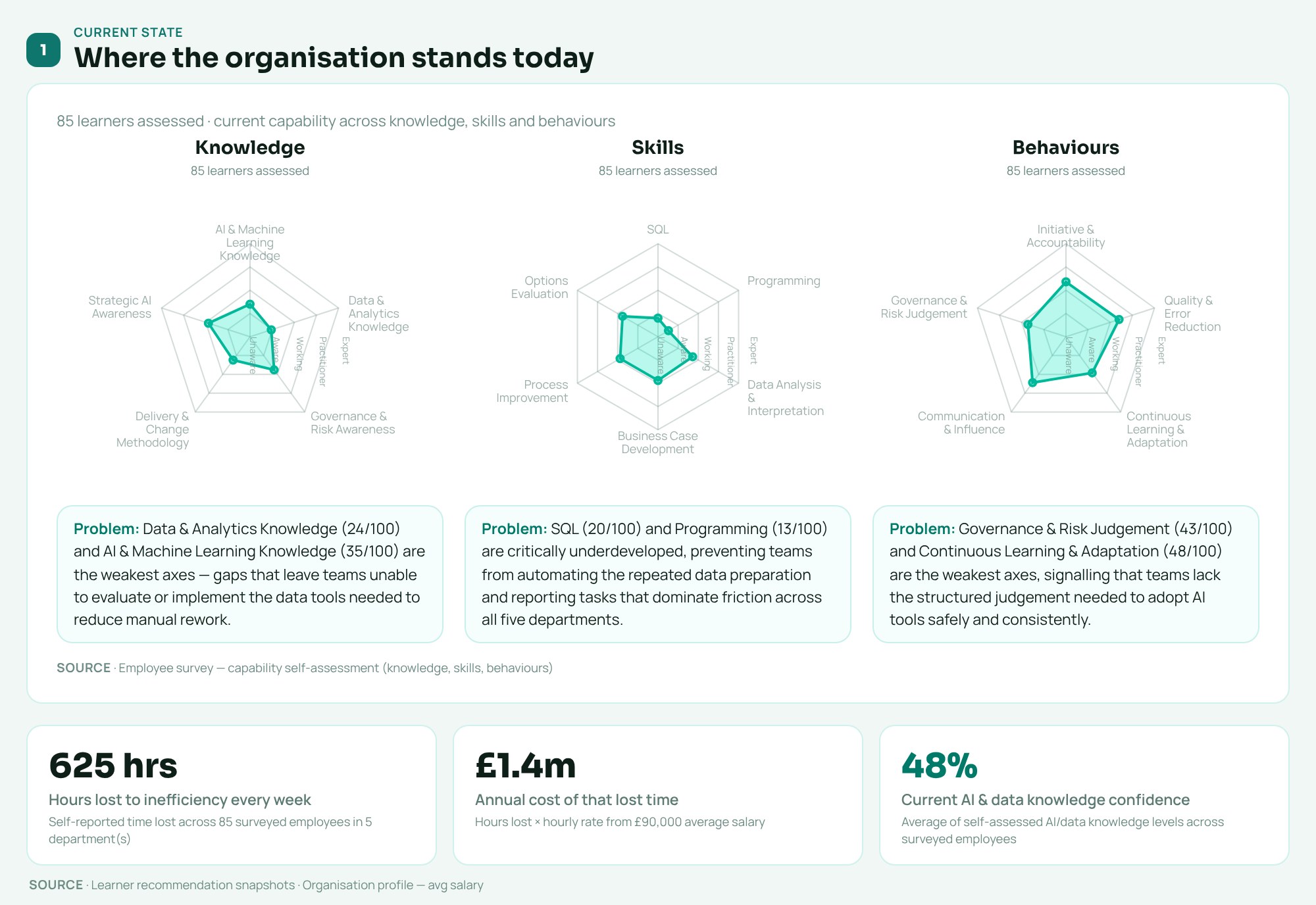
0 lost across the 85-person cohort each week
85 learners assessed · current capability across knowledge, skills and behaviours
Source · Employee survey, capability self-assessment (knowledge, skills, behaviours)
Need is measured department by department, by the people doing the work, and read against what your leaders say the business is trying to achieve.
10 Minute AssessmentCadra has no preferred provider. The diagnosis comes before any proposal, and any proposal has to answer to it.
Cadra does not deliver trainingOne shared plan, pre-populated with best practice, carries the decision from business case to a dated programme start, with managers briefed before learners hear anything.
Dated plan from approval to first dayFor the first time, the return on training is proven. Capability is measured against a baseline set before anything is bought, so ROI rests on evidence, not a finger in the air.
Before and after pictureSix connected stages in one workspace, built for the Growth and Skills Levy and cross-referenced to the KSBs of every relevant standard. The evidence carries through every one of them, and Impact feeds the next investment.
Scope, people and timeline
Leaders and employees, 10 to 15 minutes
Mapped to every relevant KSB
Board-ready, from your own data
Every action, owner and date
Evidence that it worked
Agree what you need to find out, who should be involved and when. The whole journey sits on one timeline, worked back from your programme start, so the levy is deployed in time.
A leadership survey and an employee survey measure capability across every department. It tests real project application, drive and manager support, so it works as a selection process, not just a survey. Nothing else is needed before the business case.
Answers are cross-referenced against the Knowledge, Skills and Behaviours of every relevant levy-funded programme. You see where capability sits, where it is missing and what that costs. AI contextualises and never invents, and reported time lost is treated as a signal to validate, not a saving.
The case is built from your people's answers: departmental priorities, the reported cost of standing still, who is ready, and the funded programmes that close the gap. It shows what levy is available, what is expiring and where it should go first. It reads like an internal audit, not a proposal.
One shared launch plan takes the business case to the first day of learning. Leaders hear first, then managers, then employees, so everyone knows why it matters. You choose who progresses, learners are supported through onboarding, and you see who has started on each programme.
See the difference the training made to your business. Capability is re-measured at 3, 6, 9 and 12 months and reported against the original business case: before and after results, departmental verdicts and time released, in your own terms.
Aligning AI adoption with the business objectives each leader owns, department by department, with one of England's largest apprenticeship training providers delivering the programmes.